It’s a typical evening. You plug in your phone charger, switch on the fan, and suddenly, click! Everything goes off.
You stand there wondering: “Was it the load shedding, or did my house just panic?”
Now imagine if that “click” wasn’t random, but actually saved you from a shock or even a fire.
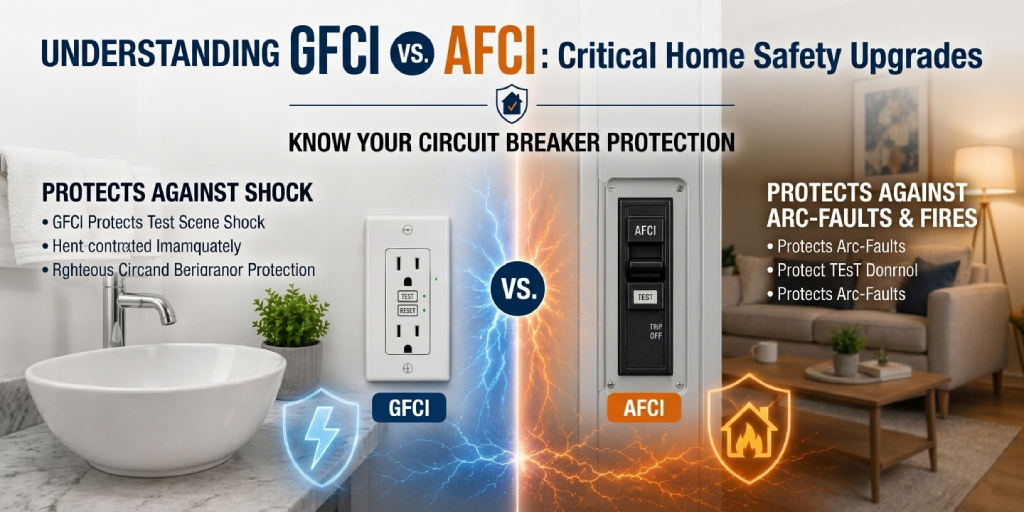
That’s where GFCI and AFCI come in. Think of them as your home’s silent bodyguards: one protects you from electric shocks, while the other protects your home from fires.
Let’s break it down.
What Is GFCI?

A Ground Fault Circuit Interrupter (GFCI) is designed to protect you from electric shock. It constantly monitors the flow of electricity in a circuit. If it detects even a small imbalance, meaning electricity is leaking somewhere it shouldn’t, it quickly shuts off the power.
How it works:
Electricity flows in a loop. If even a tiny amount leaks out, the GFCI says:
“Nope, not today!” and shuts off the power instantly.
Where you’ll find it:
- Bathrooms
- Kitchens
- Outdoor areas
- Near water sources
Why it matters:
Water + electricity = dangerous combo.
If you accidentally touch a faulty appliance with wet hands, a GFCI can literally save your life.
What Is AFCI?
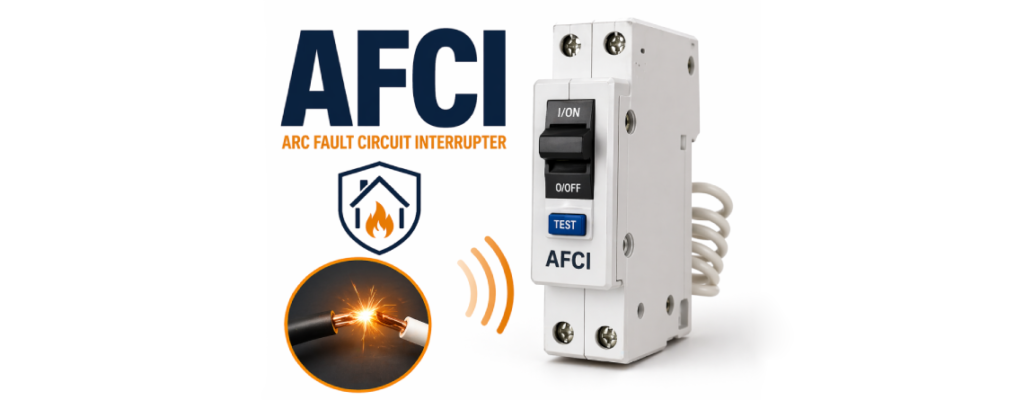
If GFCI protects you, then AFCI (Arc Fault Circuit Interrupter) protects your home.
An arc fault happens when electricity jumps between loose or damaged wires. It creates sparks (called arcs), tiny ones, but enough to start a fire inside your walls.
And here’s the scary part: you usually won’t see it coming.
How it works:
It “listens” to the electrical flow. When it detects unusual patterns (like sparking or arcing), it shuts off the circuit before things get dangerous.
Where it’s used:
- Bedrooms
- Living rooms
- Hallways
- General wiring circuits
Why it matters:
Electrical fires don’t send a warning message like: “Hi, I’ll start in 5 minutes.”
AFCI acts before you even know there’s a problem.
Ground Fault vs Arc Fault Protection: What’s the difference?
| Feature | GFCI | AFCI |
| Protects | People | Property |
| Main risk | Electric shock | Electrical fire |
| Detects | Current leakage | Sparking (arcing) |
| Common areas | Wet places | Living areas |
| Reaction speed | Instant | Instant |
In short:
- GFCI = Saves you
- AFCI = Saves your house
Why You Actually Need Both
Here’s a real-life way to think about it.
Imagine you only install GFCI. Great, you’re protected from the shocks near water. But what about a loose wire in your bedroom wall slowly sparking? That’s where AFCI jumps in.
Now flip it.
If you install only AFCIs, your home is safer from fire, but using an appliance near water could still cause a shock.
So, the safest setup? Use both.
Modern electrical safety isn’t about choosing; it’s about combining protection.
What Do Standards Say?
The National Electrical Code (NEC) is one of the most trusted electrical safety guidelines in the world. Even though it’s based in the US, its influence reaches globally, including Pakistan.
NEC requirements for GFCI and AFCI:
- GFCIs in wet and outdoor areas.
- AFCIs in living spaces.
- Increasing use of both in modern homes.
These standards aren’t just rules; they’re based on real accident data and years of safety research.
Let’s Talk About Something People Ignore: Cables
Here’s the part many people skip.
You can install the best GFCI and AFCI devices, but if your wiring is poor, you’re still at risk.
Think of cables as the “roads” electricity travels on. If the road is damaged, accidents are inevitable.
In larger systems such as commercial buildings and industrial facilities, our medium voltage cables in Pakistan play a major role. These cables carry higher loads, so the risks are bigger too.
If they are not up to standard, you could face:
- Arc faults
- Equipment damage
- Fire hazards
So whether it’s a home or a large facility, the principle stays the same: quality wiring is non-negotiable.
Can You Install GFCI and AFCI Yourself?
Short answer: You can, but should you?
If you have basic electrical knowledge, installing a GFCI outlet might seem like a weekend DIY project. It usually involves replacing a standard outlet and correctly connecting a few wires.
But here’s the thing:
Electricity is not very forgiving.
One wrong connection and instead of “DIY success,” you get:
- A tripping circuit
- A non-working outlet
- Or worse, a safety risk
AFCI breakers are even trickier since they are installed inside the main electrical panel.
Best advice:
- If you’re confident and experienced, go ahead carefully.
- If not, call a professional electrician.
Because saving a few rupees is great, but not at the cost of safety.
Common Mistakes to Avoid
Many people don’t get electrical safety right the first time.
- “I already have GFCI, that’s enough.”
Not really. You’re still exposed to fire risks without AFCI.
- Buying cheap cables.
This is probably the biggest mistake. Poor cables defeat the purpose of safety devices.
- Using indoor outlets outside.
Without weather-resistant GFCIs, this is dangerous.
- DIY without proper knowledge.
Electrical systems are not guesswork. One wrong connection can cancel all protection.
Why Choose Universal Cables for a Safer Electrical System?
This is a question worth asking, because your entire safety setup depends on it.
When you invest in safety devices like GFCIs and AFCIs, you’re already taking a smart step. But without high-quality wiring, those devices can’t perform at their best.
With internationally recognized certifications like ISO 14001:2015, KEMA Gold, and TUV Austria, UCIL (Universal Cables Industries Ltd.) offers solutions built for lasting durability, optimal efficiency, and reliable long-term performance.
UCIL is one of the leading electric cable manufacturers in Pakistan. We stand out because:
- Consistent quality and durability
- Compliance with international safety standards
- Strong insulation that reduces electrical risks
- Reliable performance in Pakistan’s varying conditions
At the End of the Day
Electrical safety isn’t something you see; it’s something you trust.
You trust that when something goes wrong, your system will respond instantly. You trust that your cables won’t fail. You trust that your home is protected even when you’re asleep.
Understanding GFCI vs AFCI is really about building that trust in your home. Because it’s not just about cables and devices, it’s about keeping people safe, every single day.
And when it comes to reliability, we offer the best electric cables in Pakistan, ensuring performance you can depend on.
Get in touch today and take the first step toward a safer, smarter electrical system.