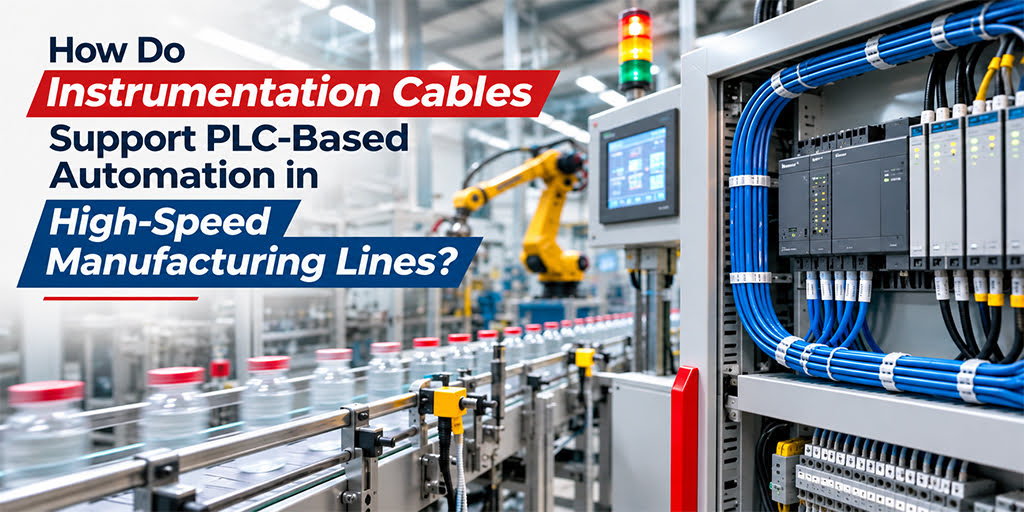
Imagine a manufacturing line producing hundreds of products every hour. Sensors continuously measure temperature, pressure, and other operating conditions. Programmable Logic Controllers (PLCs) process this information and control machines throughout the production process. But what happens when a signal becomes inaccurate or fails to reach the PLC?
Even a minor signal problem can interrupt machine operations, affect production accuracy, and cause unexpected delays. In manufacturing automation, PLCs rely on accurate signals to monitor equipment and manage production activities.
Instrumentation cables carry the signals that PLC-based systems use to monitor and control equipment. Their construction and electrical properties can affect how accurately these signals reach the control system, especially in factories with high-speed machinery.
How do instrumentation cables help PLCs monitor machines and control production on high-speed manufacturing lines? Let’s look at their role in the production process.
What Are Instrumentation Cables?
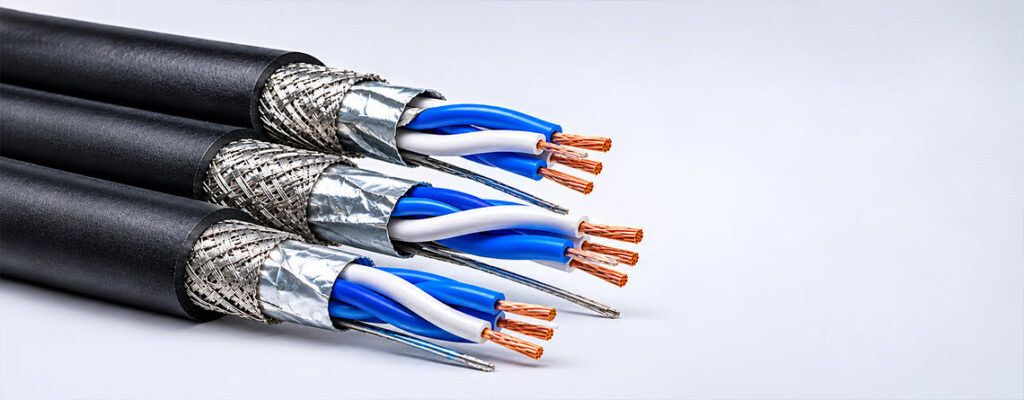
Instrumentation cables are used to carry low voltage signals between measuring instruments, sensors, controllers, and monitoring systems.
Their construction typically includes:
- Copper conductors: Carry the electrical signal between the connected devices.
- Insulation: Materials such as PVC or XLPE provide electrical insulation.
- Twisted pairs: Help reduce the effects of electromagnetic interference.
- Shielding: Aluminium foil or metallic braid can be used to shield sensitive signals from external electrical noise.
- Outer sheath: Provides protection against environmental and mechanical conditions.
Power cables are the ones that carry the power to the equipment. Instrumentation cables are the ones that carry the measurement and monitoring signals.
How Do Instrumentation Cables Support PLC-Based Manufacturing Automation?
Instrumentation cables form the physical links that enable the PLC to receive data from field devices and communicate with other control equipment.
Consider a beverage production line. Temperature sensors monitor the liquid’s temperature, pressure transmitters measure system pressure, and level sensors track liquid levels in storage tanks. All of these send their signals via instrumentation cables to the PLC.
The PLC takes the input information, processes it in accordance with its programmed logic, and then controls the relevant connected equipment via the appropriate output circuits.
This process supports automated operations such as:
- Monitoring temperature, pressure, and liquid levels.
- Detecting product positions on conveyor belts.
- Controlling the filling and packaging sequences.
- Identifying abnormal operating conditions.
- Coordinating machinery during production.
For instance, a PLC could use a level measurement signal to control a filling valve. The accuracy of that operation would in part be dependent on good sensor connections and properly configured input circuits.
Why Do PLC Systems Need Instrumentation Cables?
PLCs are entirely reliant on accurate information from the sensors and transmitters. A broken or distorted signal can result in incorrect readings, process alarms, or unnecessary production interruptions.
Industrial environments also contain motors, transformers, and variable frequency drives (VFDs), which can generate electromagnetic interference (EMI).
Shielded industrial instrumentation cables will go some way to minimizing the effects of this interference, provided they are correctly selected, installed, and earthed.
Their main advantages include:
- Signal reliability: Supports reliable communication between field instruments and PLC inputs.
- Noise reduction: Shielding helps to protect the sensitive signal from external electrical noise.
- Process monitoring: Enables the controller to receive measurements from various points in the process.
- Operational continuity: Reliable connections will help to reduce signal drop outs.
- Environmental protection: Appropriate insulation and sheathing to protect the electrical wires under the specified operating conditions.
IEC TR 61000-5-1:2023 provides general guidance on electromagnetic compatibility (EMC) in electrical installations, including measures to reduce interference.
What Cables are Required for PLC Input and Output Connections?
Different PLC connections will require different types of cable. The choice of cable will be dictated by the signal, the equipment being connected to, the voltage, and the installation requirements.
PLC Input Connections
Input connections transfer data from these field devices to the PLC for processing. Typical examples would be temperature sensors, pressure transmitters, proximity sensors, and level instruments.
Instrumentation cables are commonly used for analog signals, including 4–20 mA measurement loops. Shielded twisted pair may be appropriate in situations where there is an issue with electrical noise.
Digital sensor connections also require the appropriate PLC sensor wiring, this being selected according to the sensor output, the wiring configuration, and the PLC input specifications.
PLC Output Connections
Output connections carry control signals from the PLC to external devices, including relays, solenoid valves, indicator lights, and motor control interfaces.
These links or connections are generally used with control cables for production automation, and the spec will be dictated by the output circuit and the equipment that it’s going to.
Power Connections
PLCs, control panels, motors, and the various bits of machinery all require their own separate power connections. The appropriate LV cables are used to supply the power in accordance with the equipment ratings and installation requirements.
Instrumentation, control, and power cables all have different functions and should not be treated as being the same.
How Do Instrumentation Cables Improve High-Speed Manufacturing Performance?
High speed production lines rely on accurate and timely information from the sensors and controllers.
In automotive manufacturing, for example, sensors are used to detect the position of components, and PLCs are used to coordinate the movement of the conveyors and the robots. In food processing, you’ve got temperature and pressure measurements to allow the operator to monitor the process.
Suitable production line cables will provide the necessary communications capability via appropriate conductor, insulation, shielding, and mechanical protection.
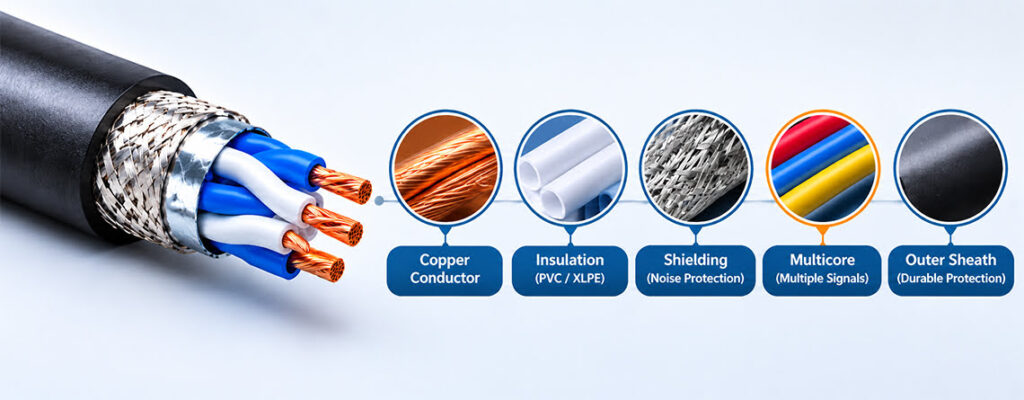
When specifying electrical wires, engineers should consider:
- Conductor material: Copper is commonly used for its electrical conductivity.
- Insulation: PVC and XLPE are selected on the basis of operating and installation conditions.
- Shielding: Overall, individual-pair, or combined shielding may be appropriate.
- Core configuration: Multicore cables can carry several signal circuits.
- Outer sheath: Protection should match exposure to moisture, chemicals, abrasion, and temperature.
Correct cable routing and separation from the power circuits will also help to maintain signal integrity.
Recommended read: Importance of Multicore Control Cables in Industrial Automation
What Should You Check Before Choosing Instrumentation Cables?
Before purchasing industrial automation cables, review the following requirements:
- Signal type: Identify analog, digital, and measurement signal requirements.
- Conductor size: Calculate the required cross-section based on electrical and installation conditions.
- Core and pair count: Match the cable to the required number of connections, allowing for future expansion.
- Shielding: Determine whether individual, overall, or combined shielding is required.
- Insulation and sheath: Check for temperature, moisture, chemical, and mechanical exposure.
- Cable flexibility: Consider fixed or moving installations.
- Applicable standards: Check the relevant IEC requirements and project specifications.
IEC 60228:2023 specifies conductor cross-sectional areas, construction, and resistance requirements for conductors used in insulated cables. It does not, by itself, establish a complete specification for instrumentation cable performance.
How Should You Install PLC Control Wiring?
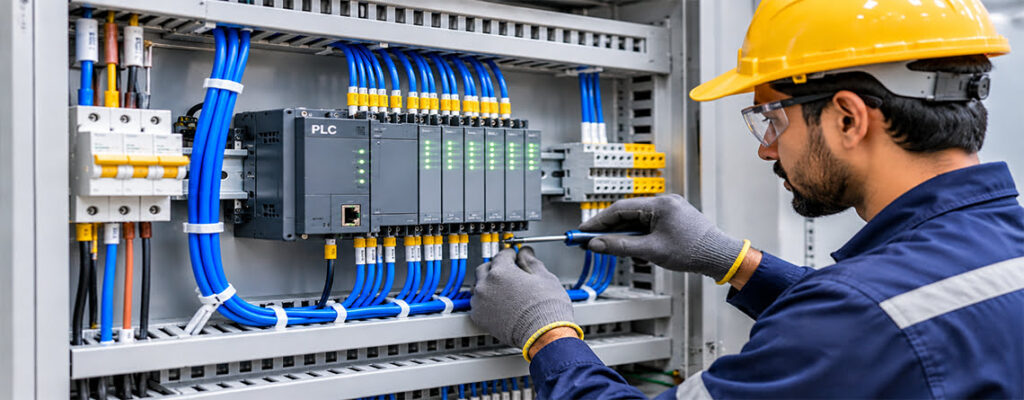
Correct installation is just as important as the cable selection. You must follow the PLC manufacturer’s wiring instructions and the relevant electrical installation requirements.
Recommended practices include:
- Route the low voltage signal cables separately from the AC and high energy switching circuits.
- Cross power cables at right angles where separation cannot be maintained.
- Follow the cable manufacturer’s minimum bend radius.
- Use appropriate glands, connectors and termination methods.
- Identify cables clearly at both ends.
- Check continuity, insulation resistance where appropriate, and the shield connections prior to commissioning.
Siemens’ S7-1200 wiring guidance also recommends suitable cable separation, correct conductor sizing, and appropriate shielding and grounding practices.
How Does Universal Cables Support Industrial Cable Requirements?
Universal Cables understands that industrial facilities require different electrical cable specifications depending on their equipment, operating conditions, and automation systems.
Whether a project involves PLC control wiring, sensor connections, or power distribution, selecting suitable cable construction is essential.
From instrumentation and control applications to copper cables and LV cables, engineers should evaluate conductor material, insulation, shielding, and environmental protection before finalizing their requirements.
Contact our team to discuss your industrial cable requirements and find options suited to your application.
Frequently Asked Questions
How do instrumentation cables support automated production lines?
They transmit measurement signals between sensors, transmitters, and PLC systems, allowing automated equipment to monitor process conditions and respond to programmed instructions.
Why do PLC systems need instrumentation cables?
PLCs need reliable connections in order to get accurate information from the field instruments. The right instrumentation cables will help to maintain signal integrity and minimize interference.
What cables are required for PLC input and output connections?
Inputs are normally via instrumentation or suitable sensor cables, and outputs are normally via control cables. Power circuits require separately specified power cables.
What is the difference between instrumentation cables and control cables?
Instrumentation cables are basically for carrying the measurement signals. Control cables carry the electrical signals that are used to operate or to coordinate the equipment.
Are shielded cables necessary for PLC sensor wiring?
Not always. Shielding will depend on the type of signal, the route of the cable, the level of electrical noise, and the PLC manufacturer’s recommendations. It can be of particular benefit in electrically noisy environments.
Can instrumentation cables be used for power transmission?
They are generally designed for signal transmission, not heavy power loads. Always check the cable’s rated voltage, current capacity, and intended application before use.