Solar panels spend years sitting outside in blazing sun, rain, humidity, dust, and changing temperatures. The panels may get most of the attention, but the cables connecting them have an equally important job.
That brings us to a common question: Are tinned copper wires safe for solar panels?
Yes. When properly manufactured and selected for the application, tinned copper wires are an excellent choice for solar panel wiring, particularly in outdoor environments. The tin coating protects copper against oxidation and corrosion without compromising the electrical properties that make copper a popular conductor.
Still, a few myths about tinned copper solar cables refuse to retire. Let’s clear them up.
Editorial note: Cable requirements vary by system voltage, installation method, environmental conditions, jurisdiction, and applicable standards. This article provides general technical guidance and should not replace project-specific engineering calculations, manufacturer instructions, or local electrical regulations.
What Is Tinned Copper Wire?
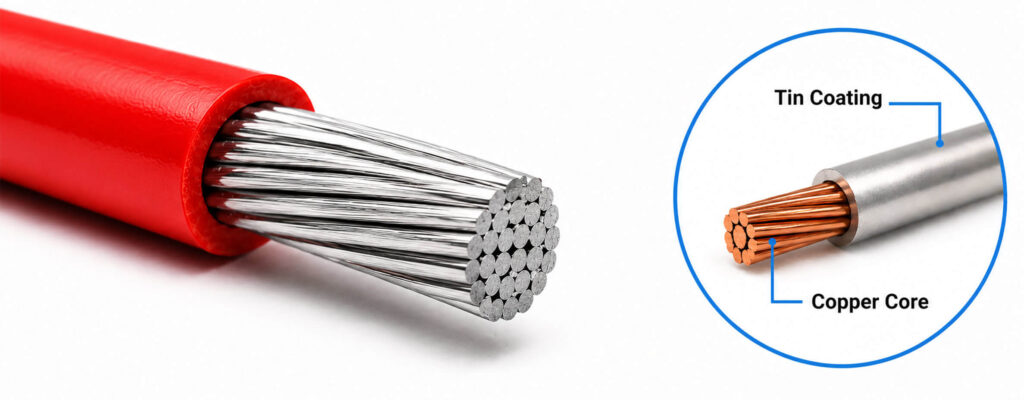
Tinned copper wire is simply copper wire coated with a thin layer of tin.
Think of copper putting on a raincoat. It is still copper underneath, but it has an extra protective layer between itself and the environment.
Bare copper is an excellent electrical conductor. However, prolonged exposure to moisture, humidity, salts, and other environmental conditions can cause its surface to oxidize or corrode.
Tin helps create an additional barrier against these conditions. That makes tinned copper particularly useful for outdoor solar wiring, where cables may need to perform reliably for many years.
Why Is Tinned Copper Preferred for Solar Wiring?
A photovoltaic system isn’t exactly a comfortable office environment for a cable.
Solar cables can face:
- High outdoor temperatures
- Direct and prolonged sunlight
- UV radiation
- Rain and moisture
- Humidity
- Dust and pollution
- Large temperature changes
- Continuous DC operation
For these reasons, good photovoltaic cables need more than a capable conductor. They also require suitable insulation and sheathing that are heat resistant, UV resistant, weather resistant, and designed for the required DC voltage and operating conditions.
Tinned copper conductors add another useful layer of durability by improving resistance to oxidation and corrosion.
Now, let’s tackle five common myths.
Myth #1: The Tin Coating Reduces Conductivity
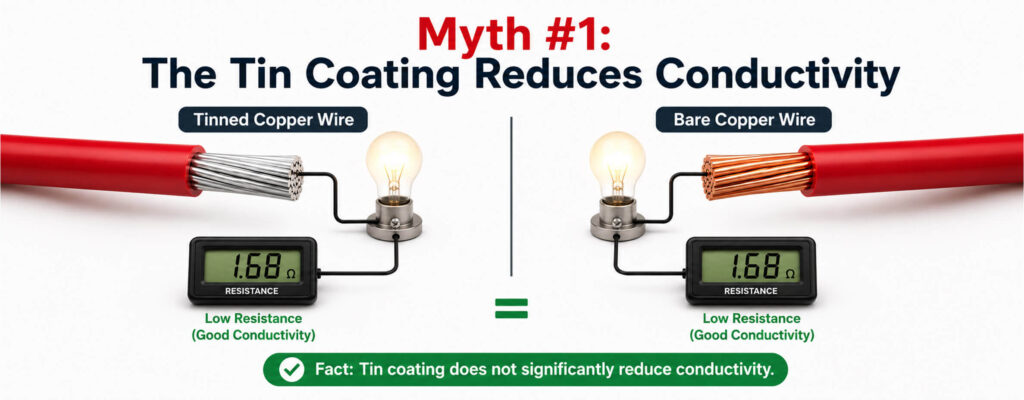
Reality: A properly manufactured tinned-copper conductor can meet the electrical performance required for photovoltaic applications.
Because tin has lower electrical conductivity than copper, it is reasonable to wonder whether tinning significantly increases cable resistance.
However, the tin coating is only a thin surface layer; the conductor remains predominantly copper. Rather than judging a cable by the presence or absence of tin, installers and system designers should check its specified conductor resistance, cross-sectional area, current-carrying capacity, temperature rating, and applicable cable standard.
In a correctly specified PV cable, these electrical characteristics, not the simple fact that the conductor is tinned, determine whether the cable is suitable for the installation.
Myth #2: Tinned Copper Boosts Solar Panel Output
Reality: Tinned copper does not increase a solar panel’s rated power. Its main advantage is better protection against oxidation and corrosion.
So, can tinned copper wire improve solar panel performance?
Not in the sense of making a 500 W panel suddenly behave like a 600 W panel.
Cable selection can, however, influence how much generated power is lost between components. Voltage drop and resistive losses depend on conductor resistance, cable length, conductor cross-sectional area, current, operating temperature, and connection quality.
Correctly sizing the cable and maintaining sound connections are therefore much more important to electrical efficiency than the tin coating itself. Tinning primarily contributes to environmental durability and long-term conductor protection.
Myth #3: Any Electrical Wire Can Be Used for Solar Panels
Reality: A copper cable is not automatically suitable for photovoltaic service.
Photovoltaic cables can spend years exposed to high temperatures, sunlight, UV radiation, moisture, temperature changes, and other environmental stresses. They may also operate continuously at DC voltages and temperatures that require specifically rated cable construction.
For that reason, solar cable selection should consider the complete cable, not just the conductor. Insulation and sheath materials, maximum voltage, temperature range, UV resistance, weather resistance, mechanical properties, installation conditions, and applicable standards all matter.
A general-purpose indoor cable should not be assumed suitable for exposed PV installation unless its specifications and applicable regulations explicitly permit that use.
Using an indoor cable outdoors because “wire is wire” is a bit like wearing bedroom slippers on a hiking trip. Technically, they’re footwear. Practically, you may regret the decision.
Myth #4: Tinned Copper Never Corrodes
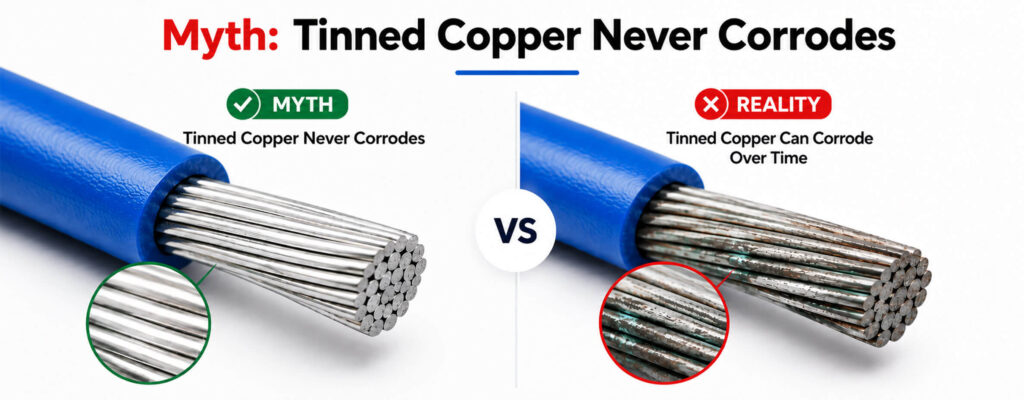
Reality: Tinning improves corrosion resistance, but it does not make an installation immune to corrosion or environmental damage.
The tin layer helps protect the underlying copper from oxidation, which can be particularly beneficial where conductor surfaces may be exposed to humid, coastal, polluted, or otherwise demanding conditions.
However, long-term PV cable reliability depends on the entire installation. Connector compatibility and termination quality, insulation integrity, water ingress protection, bend radius, mechanical stress, cable routing, operating temperature, and correct sizing can all affect performance.
Tinned copper is therefore one element of a durable PV cable design, not a substitute for correct cable construction and installation.
Myth #5: All Solar Cables Perform the Same
Reality: Cable construction and specifications can vary considerably.
Two black cables sitting next to each other may look almost identical while having very different performance characteristics.
When choosing DC cables for solar panels, consider the conductor, insulation, sheath, voltage rating, temperature rating, UV resistance, mechanical properties, and applicable standards.
Here’s a simple comparison:
| Feature | Tinned-Copper PV Cable | Bare-Copper Cable | General-Purpose Indoor Cable |
| Electrical conductivity | Excellent | Excellent | Depends on conductor |
| Protection against conductor oxidation | Enhanced by tin coating | Lower where copper is exposed | Depends on construction |
| Outdoor suitability | Yes, when appropriately rated | Depends on complete cable construction and rating | Not automatically |
| UV resistance | Determined by insulation/sheath and cable rating | Determined by insulation/sheath and cable rating | May not be provided |
| Temperature performance | According to specified PV cable rating | Depends on cable construction | Depends on cable type |
| PV system suitability | Purpose-designed when certified/rated for PV use | Possible if the complete cable is approved for the application | Not automatically suitable |
| Humid/coastal applications | Tinned conductor provides additional oxidation/corrosion protection | Copper may be more vulnerable if exposed | Depends on construction |
Suitability depends on the complete cable construction, applicable standard and installation requirements.
Related read: DC vs AC Cabling
What Type Of Wire Is Best For Solar Panels?
No single cable specification suits every photovoltaic installation.
However, for many systems, the best choice is a purpose-designed photovoltaic cable with a high-quality copper conductor, often tinned copper, and insulation and sheathing rated for the installation environment.
When selecting solar panel wiring, check:
- Conductor material: High-quality copper conductors provide good electrical conductivity.
- Correct cable size: Size the conductor for current, cable length, allowable voltage drop, installation method, and temperature.
- DC voltage rating: The cable must suit the maximum system voltage.
- UV resistance: Essential when cables are exposed to sunlight.
- Heat resistance: Solar installations can operate at high temperatures.
- Weather resistance: Outdoor cables should tolerate moisture and changing weather conditions.
- Flexibility: Flexible conductors can make routing and installation easier.
- Applicable certifications and standards: Cable requirements vary by market and installation type.
Most importantly, cable selection should follow applicable electrical regulations and the system designer’s requirements.
Related read: Hybrid Power Systems: Cable Requirements for Solar + Grid Integration
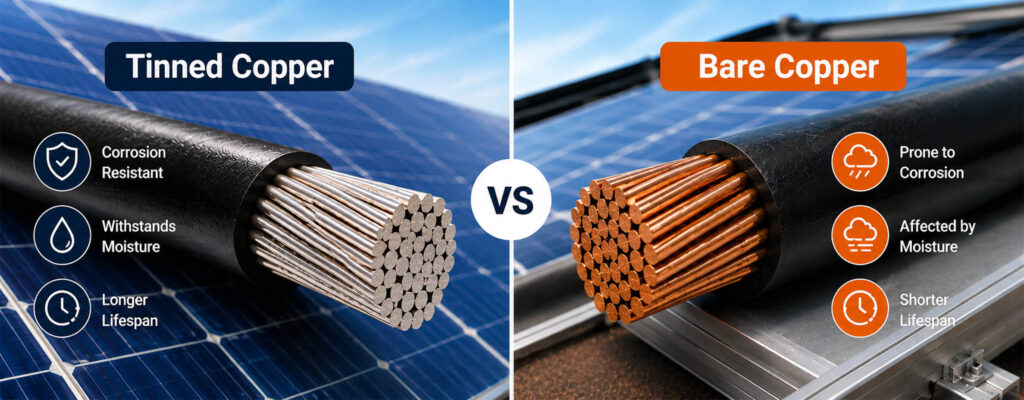
Tinned Copper vs Bare Copper: Which Is Better for Solar?
Bare copper has excellent conductivity and is widely used in electrical applications. But solar installations bring additional environmental challenges.
Tinned copper’s key advantage is its added protection against oxidation and corrosion. That can be especially valuable for rooftop systems, humid regions, industrial environments, and locations close to the sea.
This doesn’t mean bare copper is automatically unsuitable. The complete cable design matters.
For outdoor photovoltaic installations, however, tinned copper is popular for a good reason: it combines copper’s electrical performance with additional environmental protection.
Why Choose Universal Cables for Solar Panel Wiring?
A reliable solar system needs cables built for demanding conditions. Universal Cables offers quality cable solutions designed to support safe, efficient, and long-lasting power transmission.
With durable construction and options suited to different electrical and environmental requirements, Universal Cables supports residential, commercial, and industrial solar projects.
Solar panels capture the power, but the right cables keep it moving.
The Bottom Line
Tinned copper wire isn’t some sketchy shortcut; it’s actually a smart, durability-focused choice for outdoor solar wiring. The tin coating doesn’t weaken performance; it protects the copper underneath so your system keeps running smoothly for years, rain or shine (literally).
So next time someone tells you tinned copper is “risky” for solar panels, you can smile, sip your chai, and confidently say: “Nah, that’s just copper in a raincoat, and it’s doing its job just fine.”
Looking for solar-grade cables you can actually trust? Universal Cables offers a range of PV and DC solar wiring built for real outdoor conditions; no myths, no shortcuts, just solid engineering.
Frequently Asked Questions
Are tinned copper wires safe for solar panels?
Yes. They offer excellent conductivity and improved corrosion resistance for outdoor solar applications.
Can tinned copper wire improve solar panel performance?
It doesn’t increase panel output, but a properly sized cable can help minimize losses and maintain reliable performance.
What type of wire is best for solar panels?
A purpose-designed PV cable with the correct size, voltage rating, and resistance to UV, heat, and weather is generally the best choice.
Tinned copper vs bare copper: which is better?
Tinned copper offers better corrosion resistance, especially in humid, coastal, and outdoor environments.
Can ordinary electrical wire be used for solar?
Not necessarily. Solar installations require cables rated for their voltage and environmental conditions.
Does tinned copper corrode?
It can, but the tin coating significantly improves the copper’s resistance to oxidation and corrosion.
Disclaimer:
Cable requirements vary according to system design, installation method, jurisdiction, environmental conditions, and applicable regulations. Final cable selection and installation should follow the system designer’s specifications, manufacturer’s documentation, applicable electrical regulations, and relevant product standards.