AI data centers depend on reliable power distribution and high-speed connectivity to support compute-intensive workloads. As server density and network demands increase, well-planned structured cabling for data centers becomes essential for performance, maintenance, safety, and future expansion.
For operators looking at building out an AI data center infrastructure, the right cables and following the documented installation procedures will go a long way to establishing a good, solid, reliable, and serviceable base for the equipment.
Why Do Data Centers Need Structured Cabling?
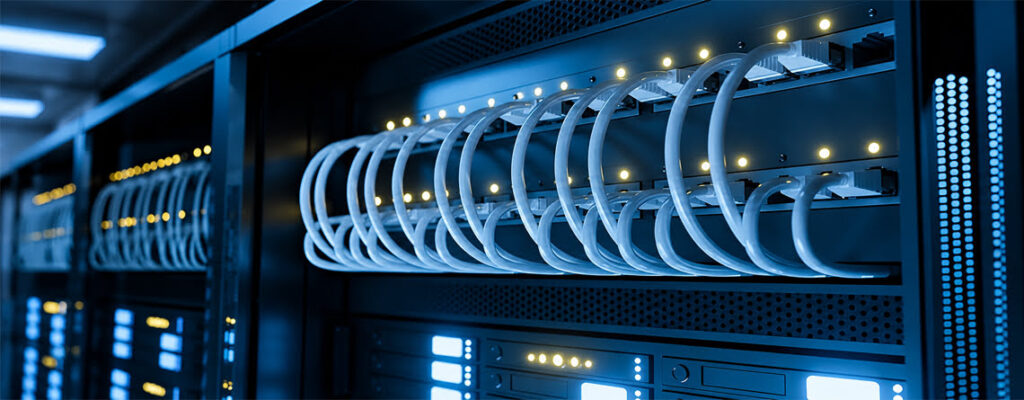
Structured cabling provides the means of connecting the servers, switches, storage, and all the other bits of network equipment via defined pathways and consistent labelling. It makes the infrastructure a lot easier to manage as the requirements for equipment and connectivity change over time.
The Telecommunications Industry Association’s ANSI/TIA-942-C standard, published in May 2024, addresses data center infrastructure, including telecommunications, electrical systems, mechanical systems, fire protection, safety, and physical security. It provides a useful planning framework but does not replace applicable electrical codes, product specifications, or installation requirements.
Key benefits include:
- Simplified maintenance: Clear labels and organized cable routes help technicians trace connections and identify faults.
- Scalability: Planned pathways and spare capacity make it easier to add equipment as requirements grow.
- Operational performance: Appropriate cable selection and correct installation help reduce connection issues and power distribution problems.
- Airflow management: Organized cable routing reduces congestion around equipment and helps maintain adequate airflow.
How Can Poor Cabling Affect Data Center Operations?
Incorrect cable selection, poor termination, inadequate support, or a congested path can all lead to operational problems. The specific nature of the fault will dictate whether the result is network errors, intermittent connectivity, power distribution problems, longer repair times, or unplanned downtime.
Cable congestion can also impede airflow around the server equipment and hence potentially lead to higher operating temperatures. Cable is of course just one of the factors in the overall thermal management of a data center, with the others being equipment density, the cooling design and the operating conditions.
Different cable types serve different purposes:
- Copper cables: Support suitable network links and other connections where the performance ratings, interfaces and transmission distances are appropriate.
- Fiber optic cables: Provide high bandwidth connectivity and support longer transmission distances depending on the type of fiber and the optical equipment.
- Control cables: For use in the monitoring, signaling, and control systems as per the facility design.
- LV cables for data centers: To support the low voltage power distribution in accordance with the electrical design and applicable ratings.
- Medium voltage cables: Carry the power within the medium voltage distribution system, e.g., to and from a transformer or other equipment.
These cable categories are not interchangeable. You have to select the right one based on the application, the system design, and the relevant standards.
Why Is Server Rack Cabling Important?
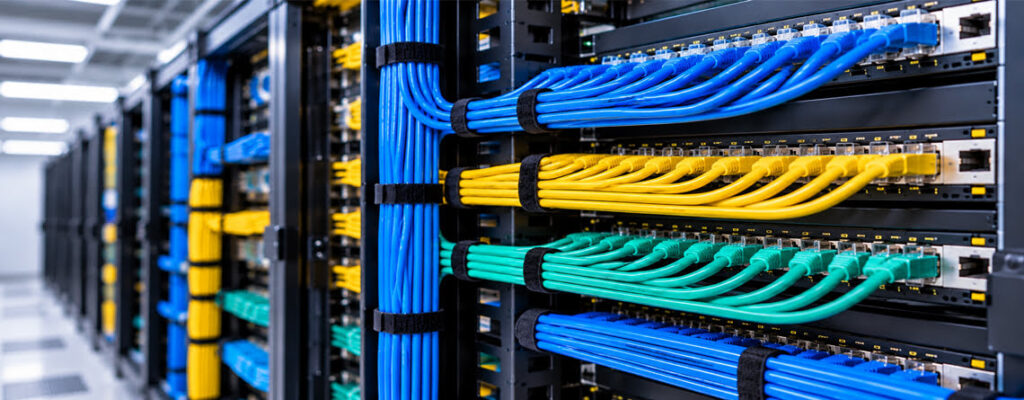
Server rack cabling is all about the cabling between the servers, the switches, and all the other associated kit, and it’s vital that there’s still access for maintenance. In high-density AI data centers, poor cable management can complicate troubleshooting, restrict airflow around equipment, and make routine maintenance more challenging.
Practical measures would be the use of the correct cable lengths, correct labeling, approved supports, and planned cable management routes. Technicians would also need to be mindful of the manufacturer’s specified bend radius, pulling limits and connector handling.
Practical Cabling Considerations for AI Data Centers
Before procurement and installation, project teams should verify:
- Network compatibility: Check link speed, cable category or fiber type, connectors, equipment interfaces, and transmission distance.
- Electrical: Verify voltage ratings, current capacity, conductor size, installation conditions, and applicable electrical codes. LV cables for data centers must meet the requirements of their intended distribution circuits.
- Routing and separation: Routing and separation: Plan cable routes according to project requirements and installation standards. Choose control cables that match the connected equipment, signal needs, and installation environment.
- Installation and testing to be carried out: In accordance with the manufacturer’s instructions, and the installed links to be tested against the applicable acceptance criteria.
- Expansion and documentation: Provide for spare pathway capacity and maintain cable schedules, labels, drawings, test records and product datasheets.
These checks help make the AI data center infrastructure easier to operate, easier to maintain and easier to scale.

How Can Universal Cables Support Data Center Projects?
Universal Cables can support the cable procurement process by helping project teams identify suitable cable solutions for their infrastructure requirements. The correct solution will of course be application dependent, dictated by the electrical and network requirements, the operating environment and the relevant standards.
Cable selection should be based on verified product documentation. Review the relevant Universal Cables datasheet to assess technical specifications, rated performance, intended applications, and documented compliance. The project engineer and the qualified installer must confirm that the product is suitable.
Conclusion
Reliable structured cabling provides the basis for connectivity, maintainability and expandability in AI data centers. We’re talking about copper and fiber optic connections, control cables, LV cables for data centers, and medium voltage cables. Each of these has a different role to play. The right specification, combined with professional installation, testing, and documentation, will go a long way to minimizing avoidable operational risks.
Contact Universal Cables to discuss your project requirements and identify suitable cable solutions.
Frequently Asked Questions
What is structured cabling in AI data centers?
It’s an organized system of cables, connections, and paths that links the network equipment and allows for easy maintenance and future expansion.
Which cables are used in AI data centers?
AI data centers use copper and fiber optic cables for network connectivity, while control cables and LV or medium voltage power cables serve control and electrical distribution functions. The exact requirements depend on the facility’s design.
How does structured cabling improve performance?
A well-designed structured cabling system improves connection traceability, streamlines troubleshooting, and supports orderly cable routing.
Why is server rack cable management important?
Good server rack cable management improves access to connections, simplifies troubleshooting, and helps maintain adequate airflow around equipment.
How should cables be selected for AI data centers?
Assess the application requirements, transmission performance, electrical ratings, installation conditions, relevant standards, and future capacity.
References
- Telecommunications Industry Association (TIA). ANSI/TIA-942: Telecommunications Infrastructure Standard for Data Centers.
- Telecommunications Industry Association (TIA). TIA-942-C Data Center Infrastructure Standard: White Paper (May 2024).