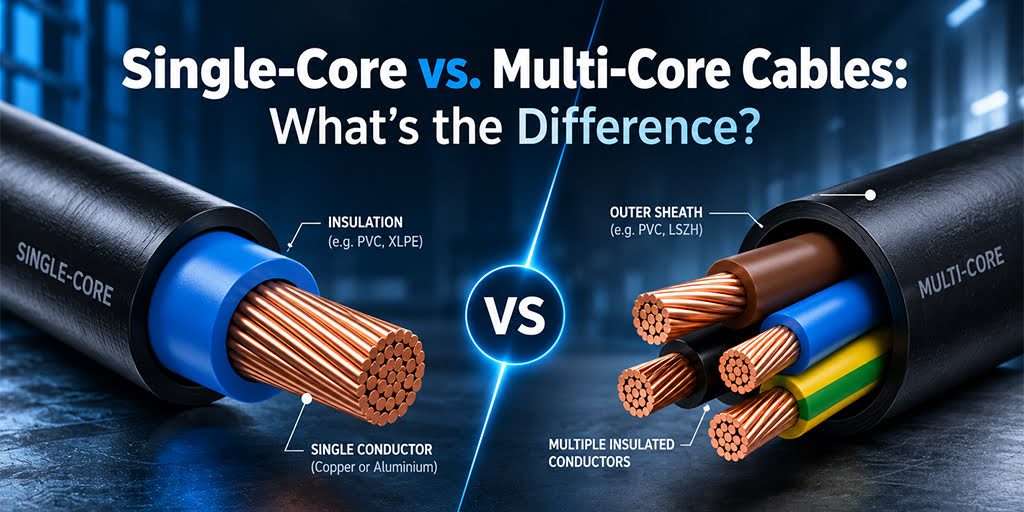
Should you choose a single-core cable or a multi-core cable for your electrical system?
The right choice depends on the application, system voltage, load current, conductor size, installation method, ambient temperature, cable grouping, environmental conditions, and applicable electrical standards. Both types are used in homes, commercial buildings, factories, solar projects, and power distribution systems.
Understanding their construction and typical applications can help engineers, contractors, and project teams narrow down the appropriate cable type before final sizing and specification.
What Is a Single-Core Cable?
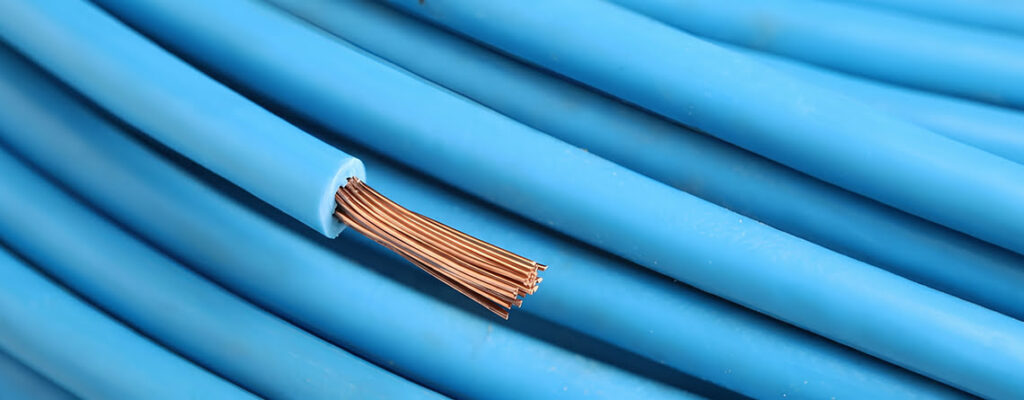
A single-core cable contains one electrical conductor inside its insulation. The conductor may be solid or stranded and is usually made from copper or aluminium.
IEC 60228 defines conductor requirements, including nominal cross-sectional areas, conductor resistance values, and classifications such as solid conductors (Class 1), stranded conductors (Class 2), and flexible conductors (Classes 5 and 6).
Single-core cables are commonly used in:
- Electrical panels
- Power distribution systems
- Building wiring
- Industrial installations
- Solar systems
- Machinery connections
Single-core cables may use copper or aluminium conductors, depending on the application, required current capacity, conductor size, weight, cost, and project specification. Single-core construction is used in certain LT, MV, wiring, and solar cable designs, although the available configuration depends on the product type, voltage rating, manufacturer specification, and applicable standard.

What Is a Multi-Core Cable?
A multi-core cable contains two or more individually insulated conductors inside one outer sheath. Depending on the cable design, these cores may carry power, control signals, instrumentation signals, or a combination permitted by the system specification. Common designs include 2-core, 3-core, 4-core, 5-core, and cables with several smaller cores.
Multi-core cables are widely used in:
- Building electrical systems
- Machinery
- Industrial automation
- Control panels
- Measurement systems
Grouping several cores within one sheath can simplify routing and termination, but you must still consider conductor count, current rating, voltage, screening requirements, bending radius, and installation conditions.
Many control cables and instrumentation cables use multi-core construction because several power or signal connections may need to run between the same points.
How Do Single-Core and Multi-Core Cables Compare?
The table below shows the main differences between single-core and multi-core cables.
| Feature | Single-Core Cable | Multi-Core Cable |
| Conductors | One conductor | Two or more conductors |
| Common Uses | Power distribution, panels, solar systems | Control, instrumentation, machinery, wiring |
| Installation | Installed individually | Multiple conductors in one cable |
| Cable Management | Needs more organization when several cables are used | Easier to manage multiple connections |
| Typical Types | LT cables, MV cables, copper wires, XLPO solar cables | General wiring cables, control cables, instrumentation cables |
| Best For | Individual or higher-current connections | Multiple power, control, or signal circuits |
Neither type is always better. The right choice depends on the application, voltage, current, installation conditions, and number of connections required.
Where Are Single-Core Cables Commonly Used?
Single-core cables are widely used where power distribution requires individual conductors.
Certain LT cables use single-core construction in low-voltage systems, while some MV cables are supplied as single-core cables for medium-voltage distribution.
They can be useful when a project requires:
- Larger conductor cross-sectional areas
- Individually routed phase conductors
- Flexible routing of separate conductors
- Cable arrangements required by the electrical design
Do not determine current-carrying capacity from core construction alone. Ampacity depends on factors including conductor material and cross-sectional area, insulation temperature rating, ambient temperature, installation method, cable grouping, ventilation, soil conditions where applicable, and relevant derating factors.
Where Are Multi-Core Cables Commonly Used?
Multi-core cables are useful when several connections need to follow the same route.
They may be used as general wiring cables in buildings and equipment, depending on the specification.
Control cables can connect motors, switches, relays, panels, and automated equipment. Instrumentation cables are commonly used for measurement, monitoring, and signal transmission.

Are Solar Cables Usually Single-Core or Multi-Core?
Many solar photovoltaic systems use single-core DC cables.
IEC 62930 applies to single-core cross-linked insulated photovoltaic cables with rated DC voltages up to 1.5 kV and specifies requirements for cable construction and performance.
XLPO solar cables use cross-linked polyolefin materials and are designed for solar environments. Depending on their specification, they may provide resistance to:
- Heat
- Sunlight
- UV exposure
- Outdoor conditions
- Mechanical stress
When selecting solar cable, consider voltage rating, temperature range, installation conditions, and applicable standards. Don’t choose a cable just because it is labeled as a solar cable; check its full technical specifications.
Which Cable Is Better for Power, Control, and Instrumentation?
Single-core cables are practical for many power applications, while multi-core power cables also suit many installations.
For control and instrumentation systems, multi-core designs are often convenient because they can group several circuits. Instrumentation cables may also need:
- Screening or shielding
- Twisted pairs
- Protection against electrical interference
- Special insulation
The right choice depends on system voltage, load current, cable length, conductor material, installation method, temperature, flexibility, and applicable standards.
Technical safety note: Follow the electrical design and relevant standards for cable selection and sizing. Consider load current, voltage drop, short-circuit capacity, installation conditions, temperature, grouping, insulation, and environmental exposure. A qualified electrical professional should verify final specifications where required.
Which Standards Should Be Checked?
The applicable standard depends on the cable type, voltage level, application, and market. Depending on the product, engineers may need to check standards covering conductor construction, insulation systems, voltage rating, fire performance, environmental resistance, or photovoltaic applications.
Examples may include IEC 60228 for cable conductors, applicable parts of IEC 60502 for certain power cables, and IEC 62930 or EN 50618 for photovoltaic cables.
Always verify the standard stated on the manufacturer’s current technical datasheet rather than assuming compliance from the cable category alone.
Why Choose Universal Cables for Different Cable Requirements?
Base cable selection on verified technical data rather than product category alone. Universal Cables provides technical specifications for its cable range covering characteristics such as conductor material and size, number of cores, voltage rating, insulation or sheath construction, and applicable standards.
When needed, customers and project teams can compare these specifications with their electrical design, installation environment, and project requirements before selecting a cable.
Our range includes:
- LT cables
- MV cables
- General wiring cables
- XLPO solar cables
- Control cables
- Instrumentation cables
- Copper wires
When selecting a product, compare the required voltage, conductor size, insulation type, number of cores, installation conditions, and project specifications with the chosen cable’s technical details.
Conclusion
Neither single-core nor multi-core cable is universally better. The appropriate construction depends on the circuit, load, voltage, conductor size, installation method, environmental conditions, number of required connections, and applicable standards.
Before specifying a cable, check the manufacturer’s technical data and confirm that the conductor size, voltage rating, insulation system, number of cores, temperature rating, and installation requirements match the electrical design.
For project-specific requirements, our technical team can help you compare suitable cable specifications for power, solar, control, instrumentation, and general electrical applications.
Contact Universal Cables today to discuss your cable needs and choose the right solution for your application.
Frequently Asked Questions
Can a single-core cable carry more current than a multi-core cable?
Not necessarily. Current capacity depends on conductor size, material, insulation, installation method, ambient conditions, and applicable derating factors.
Are solar cables always single-core?
Many photovoltaic DC cables use single-core construction, but cable selection depends on system design and manufacturer specifications.
Which cable is better for industrial applications?
Neither cable type is universally better. Selection depends on whether the application requires power distribution, control signals, instrumentation, flexibility, or simplified routing.
Sources
- IEC 60228:2023 – Conductors of insulated cables
- IEC 62930:2017 – Electric cables for photovoltaic systems with a voltage rating of 1,5 kV DC