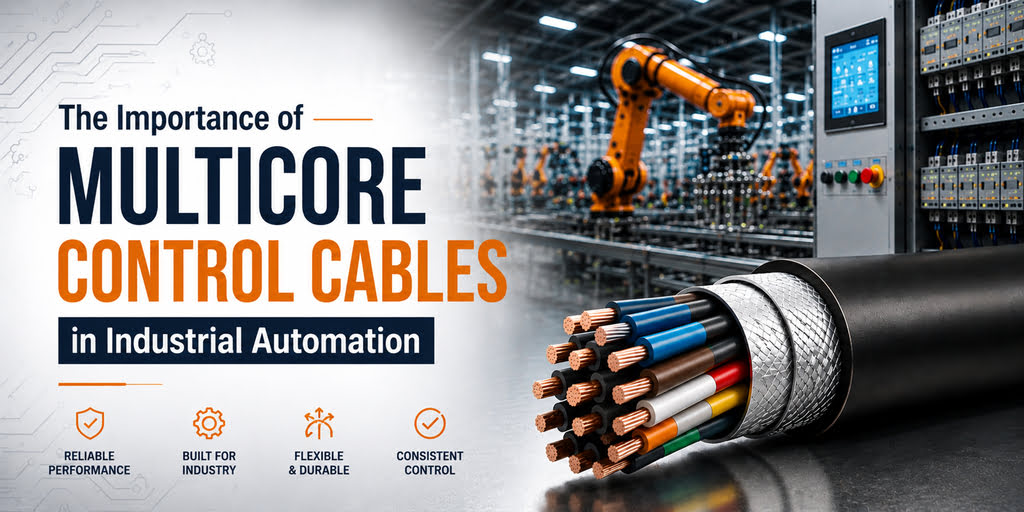
Have you ever wondered how a large industrial machine knows exactly when to start, stop, speed up, slow down, or sound an alarm?
Behind that smart automation is a network of electrical connections that carry signals between machines, sensors, switches, controllers, and control panels. Control cables are an important part of this network. They may not look as exciting as robotic arms or advanced control systems, but without reliable cables, even the smartest industrial equipment can struggle to do its job.
Think of control cables as the nervous system of an industrial automation system. The machinery may provide the muscle and the controller may act as the brain, but cables help them communicate. And just like people, machines work much better when everyone gets the message!
What Are Multicore Control Cables?
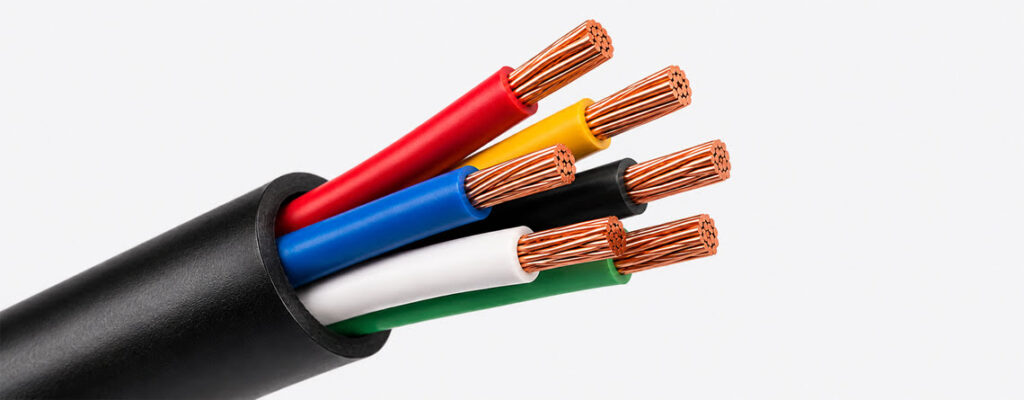
A multicore control cable contains several insulated conductors, or “cores,” inside one outer protective sheath. Instead of installing many individual wires between different pieces of equipment, engineers can use a single multicore cable to carry multiple control signals.
For example, one cable may connect several switches, sensors, relays, or other control devices to a central control panel.
This arrangement offers several practical advantages:
- Fewer individual cables need to be installed.
- Wiring inside control panels can be more organized.
- Installation can become faster and simpler.
- Cable routes can look cleaner.
- Troubleshooting and maintenance can be easier.
- One cable can handle multiple control functions.
In industrial environments where hundreds or even thousands of connections may be required, good cable organization is more than a matter of appearance. Nobody wants a control cabinet that looks like a bowl of electrical spaghetti.
How Are Multicore Control Cables Constructed?
Understanding cable construction is important because not every multicore cable is designed for the same electrical or environmental conditions.
IEC 60228:2023 specifies nominal conductor cross-sectional areas from 0.5 mm² to 3,500 mm² and includes requirements for conductor wire sizes and electrical resistance values.
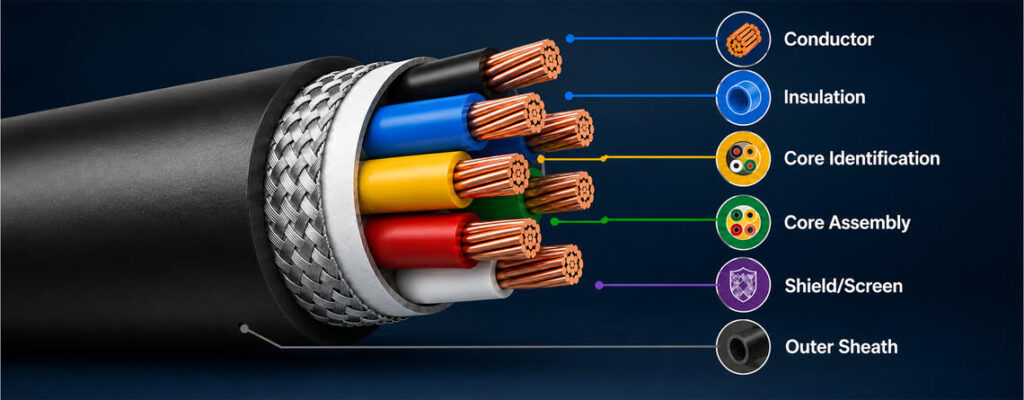
A typical multicore control cable may contain the following components:
- Conductor: Usually copper, carrying electrical current or control signals.
- Insulation: Separates individual conductors and provides electrical protection.
- Core Identification: Uses colors, numbers, or markings to simplify installation and maintenance.
- Core Assembly: Groups insulated conductors together, sometimes with fillers for cable shape.
- Shield/Screen: Foil, braid, or other metallic screening may be used to reduce EMI where required.
- Outer Sheath: Protects internal components from moisture, oils, chemicals, abrasion, and other environmental conditions.
Specification Note: The presence of a particular construction feature does not by itself establish suitability for an application. Always verify the cable manufacturer’s technical documentation and applicable project requirements. Reference standards such as IEC 60228:2023 only where the product documentation confirms their applicability.
Why Are Control Cables Important In Industrial Automation?
Automation depends heavily on communication. Sensors collect information, controllers process it, and equipment responds according to programmed instructions. Control cables provide physical pathways for many of these electrical control signals.
Suppose a sensor detects that a production line has reached a certain position. It sends a signal to the controller, which may then instruct a motor, valve, or another device to respond.
Reliable cabling helps ensure these signals reach the correct equipment consistently.
Multicore Control cables are commonly useful for:
- Control circuits
- Industrial machinery
- Manufacturing and production lines
- Process control equipment
- Control panels
- Motors and drives
- Switchgear
- Building and factory automation
When you select cables correctly for the application, they support smoother communication between different parts of an automation system.
How Do Multicore Cables Make Installation Easier?
Imagine installing ten separate cables when one appropriately selected multicore cable could carry the required connections. That’s like taking ten taxis when everyone could comfortably fit in one bus.
Multicore cables can simplify cable management because several conductors are grouped within a common sheath.
This can reduce the number of separate cable runs required between equipment and control panels. It can also make cable trays and routing systems easier to organize.
A cleaner installation can bring additional benefits during maintenance. Technicians can identify cable routes more easily, and organized wiring can reduce confusion during inspections, repairs, or upgrades.
For large industrial facilities, these small improvements can make a meaningful difference.
What Is The Role of Low-Voltage Cables In Automation?
Many industrial control and signaling applications operate at relatively low voltages compared with cables designed for high-power transmission.
Low voltage cables may be used for power distribution as well as control and auxiliary applications, depending on their design and rating. In automation environments, suitable cables connect equipment while meeting the system’s electrical and mechanical requirements.
However, never base cable selection on voltage alone. Engineers also need to consider factors such as:
- Current and voltage ratings
- Number and size of conductors
- Installation environment
- Temperature conditions
- Flexibility requirements
- Exposure to chemicals, oils, or moisture
- Mechanical stress
- Relevant standards and regulations
The right cable is suited to the actual operating conditions, not simply the one that fits through the cable tray.
How Are Instrumentation Cables Different From Control Cables?
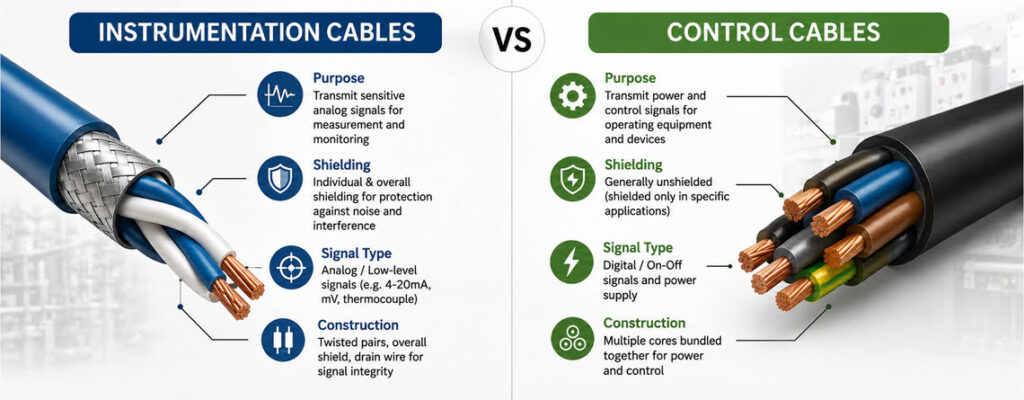
Instrumentation cables and control cables may both appear in industrial facilities, but their purposes can differ.
Instrumentation cables commonly transmit measurement and data signals from instruments such as temperature, pressure, level, and flow sensors. These signals may be relatively sensitive to electrical interference.
Control cables, meanwhile, commonly transmit commands and control signals between different parts of machinery and automation equipment.
Both play valuable roles. In a modern plant, instrumentation cables can help tell the system what is happening, while control cables help communicate what should happen next.
Together, they create a connected, responsive automation environment.
Shielded Vs. Unshielded Control Cables for Industrial Automation
One common consideration in industrial automation is shielded vs unshielded control cables.
| Factor | Shielded control cable | Unshielded control cable |
| EMI environment | May help reduce susceptibility to electromagnetic interference when correctly specified and installed | More appropriate where EMI exposure and signal susceptibility do not require shielding |
| Routing near VFD/motor circuits | May be required depending on circuit type, routing, equipment instructions and EMC requirements | Separation or alternative routing may be necessary |
| Installation | Shield termination and grounding/bonding require appropriate design | Generally simpler |
| Selection | Based on signal type, EMC environment, equipment requirements and applicable standards | Based on the same system-level assessment |
Shielding is not automatically better for every application.
The decision should consider the signal or circuit type, equipment requirements, cable routing, surrounding electromagnetic environment, installation practices, shield termination, grounding/bonding arrangements, and applicable EMC requirements.
ABB guidance for relevant drive installations recommends appropriate separation between motor, input-power, and control cabling, including separate cable trays in applicable configurations.
Always consult the instructions for the actual drive, equipment, and cable being installed.
How Do Control Cables Improve Automation Systems?
An industrial automation system is only as dependable as the components connecting it.
Correctly specified multicore control cables can support reliable signal transmission while providing suitable mechanical and environmental protection. Depending on the application, the cable may need to withstand bending, vibration, heat, moisture, oil, chemicals, or other challenging conditions.
Choosing cables with the appropriate construction can help:
- Maintain consistent control signals
- Reduce interference-related problems
- Support organized installations
- Reduce unnecessary maintenance difficulties
- Protect conductors from environmental conditions
- Support long-term system performance
This is particularly important in industries where unexpected downtime can interrupt production and increase operating costs.
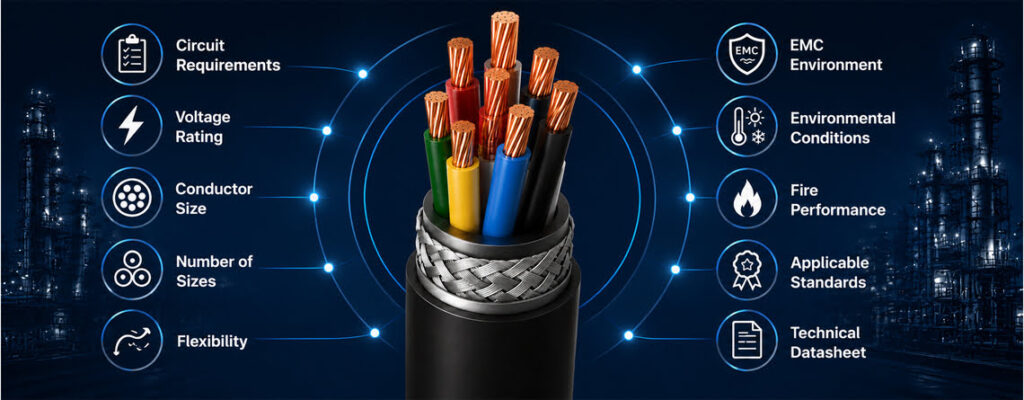
How to Select a Multicore Control Cable
When evaluating a multicore control cable for an industrial project, confirm the following parameters against the equipment requirements, cable datasheet, and applicable standards.
IEC 60332-1-2:2025 defines a test procedure for vertical flame propagation on a single insulated wire or cable using a 1 kW pre-mixed flame; passing this test alone does not establish fire-propagation performance when cables are installed as a group.
- Circuit Requirements: Identify whether the cable will carry switching signals, relay circuits, interlocks, status contacts, or auxiliary functions.
- Voltage Rating: Ensure the cable rating matches the circuit and installation requirements.
- Conductor Size: Consider current, cable length, voltage drop, and termination requirements.
- Number of Cores: Select enough conductors for the system, including spare cores where required.
- Flexibility: Choose construction suitable for fixed, vibrating, or moving applications.
- EMC Environment: Assess nearby motors, drives, and power cables and determine whether shielding is needed.
- Environmental Conditions: Consider temperature, moisture, oils, chemicals, abrasion, and mechanical stress.
- Fire Performance: Check specified flame-propagation and other fire-performance requirements, such as IEC 60332-1-2:2025.
- Applicable Standards: Verify relevant standards, including IEC, and applicable local requirements.
- Technical Datasheet: Confirm conductor, cores, voltage, insulation, sheath, shielding, temperature, diameter, bending, and compliance specifications.
Editor’s note: This guide provides general technical information about multicore control cables. Always verify final cable selection against the equipment manufacturer’s requirements, the cable manufacturer’s technical datasheet, applicable IEC standards, and local electrical regulations.
Choosing the Right Cable for Industrial Automation
Multicore control cables may work behind the scenes, but they play an important role in keeping industrial automation systems connected, organized, and dependable.
The right cable isn’t simply the one with the most cores or the heaviest construction. Its voltage rating, conductor size and construction, insulation, sheath, flexibility, EMC characteristics, environmental performance, and applicable standards should match the installation requirements.
Universal Cables offers cable solutions for electrical and industrial applications. When selecting multicore control cables, low-voltage cables, or instrumentation cables, review the relevant technical datasheet and project requirements before finalizing the specification.
For project-specific cable selection, contact Universal Cables to identify a cable construction suited to your technical and operating requirements.
FAQs
What is a multicore control cable?
A cable containing multiple insulated conductors within one protective sheath.
Where are multicore control cables used?
They are commonly used in machinery, control panels, process equipment, and industrial automation systems.
When is shielding required?
Shielding may be needed where electromagnetic interference (EMI) could affect control signals.
How do I select the right control cable?
Consider voltage, conductor size, and number of cores, flexibility, EMC conditions, and the installation environment.
Are control cables and instrumentation cables the same?
No. Instrumentation cables commonly carry measurement signals, while control cables typically carry commands and control signals.
Editorial & Technical Disclosure
This content is intended to provide educational information rather than project-specific electrical engineering advice. Product suitability depends on the complete application and installation requirements.
Universal Cables recommends reviewing the manufacturer’s current technical documentation and relevant equipment instructions and obtaining professional technical guidance where required before final cable specification or installation.
Sources:
- IEC 60228:2023 — Conductors of insulated cables
- ABB — Application Guide: Aspects of Electromagnetic Compatibility
- IEC 60332-1-2:2025 — Vertical flame propagation test